Étuis pour iPad Pro/Air
 Coques Galaxy Tab
 Clavier magnétique pour iPad
 Étuis pour Xiaomi Pad
 Accessoires pour tablettes
 Série iPhone 18
 Série iPhone 17
 Série iPhone 16
 Série iPhone 15
 Série iPhone 14
 Série iPhone 13
 Galaxy Z Fold & Flip Series
 Galaxy S26 Series
 Série Galaxy S25
 Série Galaxy S24
 Série Galaxy S23
 Série Google Pixel 11
 Google Pixel Série 10
 Série Google Pixel 9
 Série Xiaomi
 OnePlus Série
 Série Oppo
 Série Vivo
 Série Huawei Honor
 Série Rien
 Série iPhone
 Samsung Galaxy Série
 Série Google
 Série Xiaomi
 Série OPPO
 Clavier pliable
 Haut-parleurs
 Ordinateur portable
 Santé
Santé
 Support de portefeuille magnétique
 Station de recharge RayDock
 Chargeurs et câbles
 Supports et supports pour téléphone
 Chargeur de voiture
 Soldes de la rentrée 🎒
The Keyboard Question Every Hybrid Worker Eventually Faces
You have 20 minutes before boarding and a few emails still need replies. Your phone can handle it, but this is exactly when having the right keyboard can make a difference.
This scenario plays out constantly. An estimated 470 million domestic business trips were taken in the U.S. in 2025, and 77% of professionals take up to five work trips per year. Staying productive on the move is a mainstream challenge, not a niche concern.
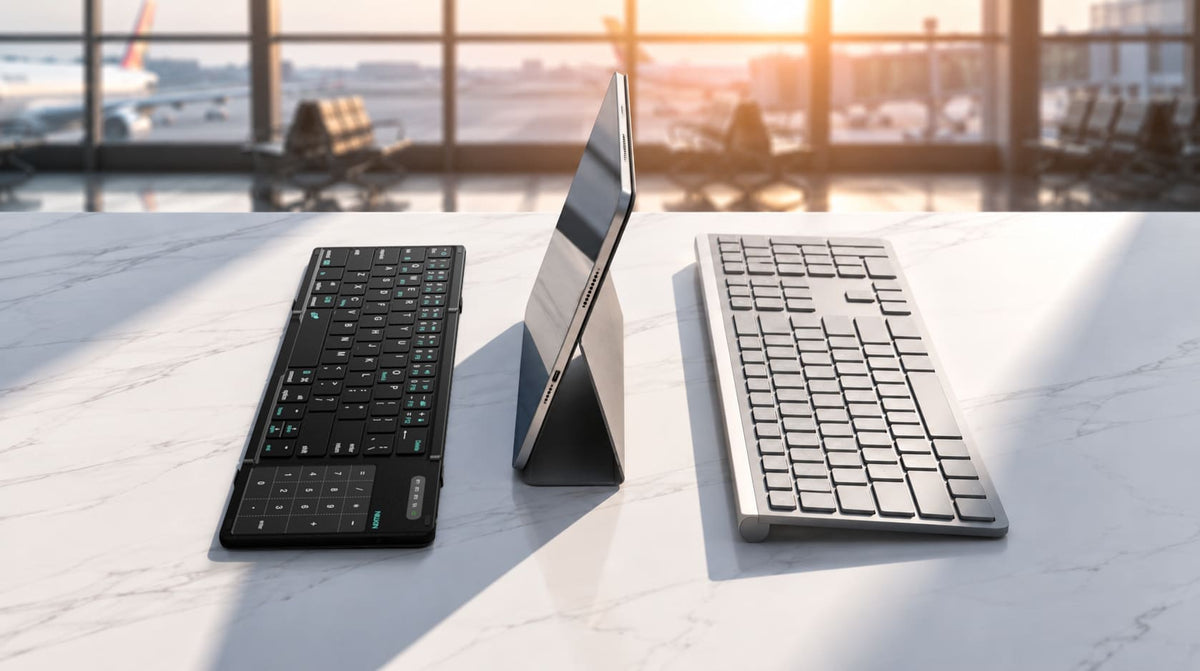
So which keyboard belongs in your bag? This guide offers a practical, neutral comparison between foldable Bluetooth keyboards and full-size keyboards across the dimensions that actually matter: portability, typing comfort, multi-device support, and ideal use cases.
Full-Size Keyboards: Built for the Desk, Optimized for Speed
The standard full-size keyboard uses a 19.05mm key pitch between key centers. That measurement wasn't chosen randomly. It's the product of decades of ergonomic refinement, carefully matched to human finger spacing and muscle memory. When you sit down at a full-size keyboard, your fingers know where to go.
Research by Lugay et al. (2022) confirmed what many touch typists already sense: mechanical full-size keyboards produce the best typing speeds compared to laptop, standard, and foldable alternatives. For anyone spending hours drafting documents, writing code, or composing long-form content, that speed advantage compounds over a full workday.
Full-size keyboards also come with ergonomic tradeoffs worth understanding. Their width pushes your mouse farther from your body's center, increasing shoulder strain. Biomechanical data shows that a 45° wrist extension raises carpal tunnel pressure to 4.0 kPa, compared to just 1.9 kPa at a neutral position. Proper desk setup and wrist positioning matter more than most people realize.
Then there's the portability problem. Most full-size wireless keyboards weigh between 500g and over 1kg. They need dedicated bag space and a flat desk to be useful. Packing one in a carry-on for a two-day trip rarely makes sense.
On the upside, battery life is generous. Many full-size wireless models run on AA batteries with months of standby time, so you're rarely caught without power.
The ideal user: someone with a permanent or semi-permanent desk who prioritizes typing speed and accuracy above all else.
Foldable Bluetooth Keyboards: Engineered for Life on the Move
A foldable keyboard takes a fundamentally different approach. Tri-fold or bi-fold designs collapse to smartphone-sized dimensions, typically under 16mm thick and weighing between 250g and 280g. They fit in jacket pockets, small bag compartments, and places where a full-size keyboard simply cannot go.
This isn't a novelty category. The foldable keyboard segment is growing at a 14.61% CAGR, more than 14 times faster than the overall keyboard market's 1.0% growth rate. That pace reflects a structural shift driven by hybrid work and mobile-first workflows, not a passing trend.
Honesty matters here: most foldable keyboards use a reduced key pitch compared to the 19.05mm standard. If you're a trained touch typist, expect a real adaptation period. It might take days, sometimes weeks, to reach your normal speed on a compact layout. This is a genuine limitation, not something to gloss over.
Where foldable keyboards pull ahead decisively is multi-device Bluetooth switching. About 62% of knowledge workers use two or more mobile devices daily, and 32% of wireless keyboards now offer simultaneous multi-device connectivity. One-button switching between your phone, tablet, and laptop eliminates the constant re-pairing that kills momentum.
There are practical constraints to keep in mind. Most foldable keyboards need a flat surface; using one on your lap during a flight or train ride can be frustrating. Models with integrated touchpads, however, effectively replace two accessories with one, cutting down on what you need to carry.
The Nillkin Cube Pocket Keyboard is designed around that kind of travel. It folds down to just 182 × 108 × 16 mm and weighs 238g, making it easy to slip into a backpack or everyday carry bag without taking up much space.
Once unfolded, you get a 64-key layout with a built-in touchpad, plus Bluetooth pairing for up to three devices. It works across iOS, Android, Windows, and macOS, so you can move between a phone, tablet, or laptop without carrying a separate keyboard for each device.
That’s really the appeal of a foldable keyboard: less space in your bag, without giving up a proper typing setup when you need one.
Side-by-Side Comparison: Key Dimensions That Matter
Numbers tell the story more clearly than opinions. Here's how the two keyboard types stack up across the dimensions that affect daily use:
| Dimension | Foldable Bluetooth Keyboard | Full-Size Keyboard |
|---|---|---|
| Portability & Weight | Under 250g; jacket-pocket size | 500g to 1kg+; requires dedicated bag space |
| Folded/Packed Size | Smartphone-sized when folded (e.g., 182 x 108 x 16mm) | Full footprint at all times |
| Key Pitch & Typing Comfort | Reduced pitch; expect an adaptation period for touch typists | Standard 19.05mm; optimized for speed and accuracy |
| Setup Time | Unfold and pair in seconds | Always ready, but requires desk space and a separate mouse |
| Multi-Device Bluetooth | Many models support 3-device switching | Varies; only 32% of wireless keyboards offer multi-device connectivity |
| Desk Space Required | Minimal; works on café tables, tray tables, small surfaces | Full desk footprint plus mouse space |
| Battery Life | 10+ hours active use from compact batteries (e.g., 500mAh) | AA batteries lasting months on standby |
| Best Use Case | Travel, cafés, coworking, multi-device mobile workflows | Long daily typing sessions, fixed desks |
Neither option is universally superior. The right choice depends entirely on where and how you work.
Who Should Choose a Foldable Keyboard?
Business travelers: If you take three to five trips per year (the most common frequency among surveyed U.S. business travelers), a foldable keyboard fits in a carry-on or jacket pocket and turns any hotel desk, airport lounge, or conference table into a workstation.
Bleisure travelers: About 55% of business travelers blended work and personal trips in recent years. A foldable keyboard is light enough for a personal daypack and capable enough for a full workday.
Café and library workers: A foldable keyboard with an integrated touchpad eliminates the need for a mouse, reducing table clutter and setup friction in shared spaces.
Coworking space users and students: Quick setup, quiet scissor-switch keys, and a compact footprint make foldable keyboards well-suited to shared or noise-sensitive environments.
Multi-device professionals: If you regularly switch between a laptop, tablet, and smartphone throughout the day (as 62% of knowledge workers do), one-button Bluetooth switching is a genuine time-saver.
Tablet-as-workstation users: As tablets increasingly handle core work tasks, a foldable keyboard transforms an iPad or Android tablet into a lightweight laptop alternative without the bulk of a keyboard case.
Who Should Stick With a Full-Size Keyboard?
High-volume writers and coders: If your workday involves six to eight hours of continuous typing, the standard 19.05mm key pitch and full key travel of a full-size keyboard will deliver measurably better speed and accuracy. The research supports this clearly.
Permanent desk workers: If you work from a fixed home office or corporate desk every day, the portability advantage of a foldable keyboard is irrelevant. Invest in the typing experience instead.
Users sensitive to adaptation periods: Switching from a full-size to a foldable keyboard requires relearning muscle memory. If you can't afford a productivity dip during the transition, stay with what you know.
Gamers and power users who need a numpad: Most foldable keyboards omit a dedicated number pad (though some, like the Nillkin Cube Pocket, integrate numpad functionality into the touchpad). Full-size keyboards remain the standard for numpad-dependent workflows.
When NOT to buy a foldable keyboard: If you never leave your desk, if you type more than 5,000 words a day, or if you need lap-stable typing on a commute, a foldable keyboard may frustrate more than it helps. Knowing when a product isn't right for you is just as important as knowing when it is.
The Verdict: Match Your Keyboard to Your Workflow
The framework is straightforward. Full-size keyboards win on typing speed, key comfort, and long-session ergonomics. Foldable Bluetooth keyboards win on portability, multi-device flexibility, and travel readiness.
For most professionals, the practical reality is this: with 52% of remote-capable U.S. workers now hybrid and nearly 8 in 10 operating across multiple locations, owning both makes sense. A full-size keyboard for the home office. A foldable for the road.
The best keyboard is the one that fits where you actually work, not the one with the longest spec sheet.
If portability matters more than a full-size typing experience, a foldable keyboard may be the better fit. The Nillkin Cube Pocket Keyboard is built for that kind of flexibility — compact enough for travel, compatible with iOS, Android, Windows, and macOS, and able to connect with up to three devices for easy switching between your phone, tablet, and laptop.